
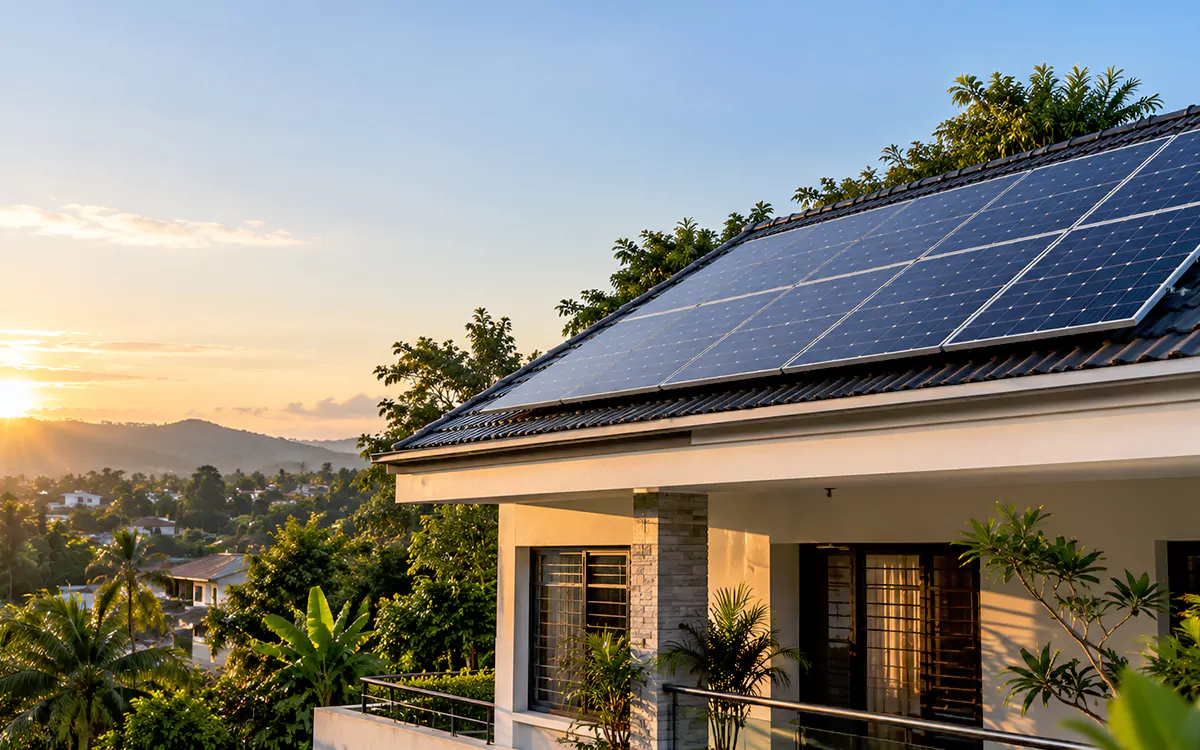
How to Choose the Best Solar Plant for Your Home
உங்கள் வீட்டுக்கு சிறந்த சோலார் — சரியாகத் தேர்வு செய்வது எப்படி?
Tamil Nadu is one of India's sunniest states — and one of its most solar-ready. But walk into any market from Chennai to Coimbatore and you'll hear a dozen different "best" options. This guide cuts through the noise so you can choose a rooftop solar plant that fits your home, your bill and your budget.
How a rooftop solar plant powers your home
1Why rooftop solar makes sense in Tamil Nadu
Most of Tamil Nadu gets strong sunshine for close to 300 days a year. A well-installed system here typically generates around 4 units (kWh) per kW every day — roughly 1,400–1,500 units per kW per year.
Because TNPDCL bills domestic consumers bi-monthly on a slab system, every unit you produce yourself cuts consumption from your most expensive slabs first. For many homes, that means the electricity bill drops to just the fixed charges.
What 1 kW of solar generates each month in Tamil Nadu
With the central PM Surya Ghar subsidy plus Tamil Nadu's newly announced state top-up, eligible homes can get up to ₹1 lakh off a 3 kW system — the best time yet to switch.
2Size your plant from your TNPDCL bill
The single biggest mistake buyers make is choosing a size based on a salesperson's guess. Your bill already has the answer. Look at the units consumed on your last 3–6 bi-monthly bills and take the average (summer bills will be higher because of ACs — plan for them).
The simple Tamil Nadu rule: bi-monthly units ÷ 240 = kW needed.
| Bi-monthly units | Typical home | Recommended size | Roof space (approx.) |
|---|---|---|---|
| Up to 250 | 1BHK, fans & lights | 1 kW | 80–100 sq ft |
| 250–500 | 2BHK, 1 AC | 2 kW | 160–200 sq ft |
| 500–750 | 3BHK, 2 ACs | 3 kW | 240–300 sq ft |
| 750–1,200 | Independent house, 3+ ACs | 4–5 kW | 320–500 sq ft |
| 1,200+ | Large villa, EV charging | 5–10 kW | 500+ sq ft |
⚡ Quick solar size calculator
Estimate only, based on ~4 units/kW/day. Final sizing depends on roof direction, shading and your sanctioned load — confirm with a site survey.
Check your sanctioned load on the bill. Your solar capacity generally can't exceed it, so if you plan a bigger system, apply to TNPDCL for a load enhancement first.
3On-grid, hybrid or off-grid?
This decision depends mostly on how reliable the power supply is in your area.
On-grid
Connects to TNPDCL via net meter. Lowest cost, highest savings, eligible for subsidy. No backup during power cuts.
Hybrid
Grid-connected with a battery bank. Keeps essentials running during cuts. Costs 40–70% more due to batteries.
Off-grid
Fully battery-based, no grid connection. For farmhouses or areas with no reliable supply. Not eligible for net metering.
For homes in Chennai, Coimbatore, Madurai, Tiruchirappalli and Salem with dependable supply, on-grid is almost always the smartest choice. In rural pockets or delta districts that see long outages during the monsoon, a hybrid system is worth the extra spend.
4Choosing the right solar panels
Panels make up the largest share of your system cost and decide how much power you'll get for the next 25 years. Compare them on these points:
Panel technology
- Mono PERC — proven, affordable, around 20–21% efficiency. A solid value choice.
- TOPCon (N-type) — higher efficiency (22%+), lower degradation and better heat performance. Ideal for Tamil Nadu summers and small roofs.
- Bifacial — generates from both sides; useful on elevated structures over light-coloured terraces.
Panel technologies compared
What to check on the datasheet
- Temperature coefficient — lower is better (around −0.30%/°C or better). Rooftops in Vellore or Karur easily cross 60°C in May; a poor coefficient costs you real units.
- Degradation & warranty — look for a 25–30 year performance warranty and at least 10–12 years on the product.
- Subsidy compliance — to claim the PM Surya Ghar subsidy, panels must be made in India (DCR) and on the government's ALMM list. Insist on seeing this in writing.
- Tier-1 manufacturer — stick to established brands with a service presence in Tamil Nadu.
5Choosing the inverter
The inverter is the brain of your system — and the component most likely to need service. Don't let it be an afterthought.
- Size match: inverter capacity should be close to panel capacity (a slight DC overload of 10–20% is normal and efficient).
- Efficiency: choose 97%+ peak efficiency.
- Monitoring: Wi-Fi / app monitoring lets you spot drops in generation immediately.
- Heat & dust: IP65 rating minimum, and install it in a shaded, ventilated spot — never in direct afternoon sun.
- Service: ask where the nearest service centre is. A 5-year warranty means nothing if the replacement takes two months.
6Built for Tamil Nadu's climate
A solar plant that works in Bengaluru may not survive Tamil Nadu's coast. Your installer should design for your district:
Coastal belt
Chennai · Cuddalore · Nagapattinam · Thoothukudi · RameswaramChallenge: salt corrosion and cyclones.
Ask for: hot-dip galvanised or aluminium structure, SS fasteners, cyclone-rated wind design.
Hot interior
Madurai · Vellore · Karur · TiruchirappalliChallenge: extreme summer heat.
Ask for: TOPCon panels, raised structure for airflow, low temperature coefficient.
Western belt
Coimbatore · Tiruppur · ErodeChallenge: dust and strong winds.
Ask for: easy cleaning access, robust anchoring, water point on the terrace.
Cauvery delta
Thanjavur · TiruvarurChallenge: heavy monsoon and outages.
Ask for: proper earthing, lightning arrester, consider a hybrid system.
Every system needs proper earthing, a lightning arrester and DC/AC surge protection. These are cheap to include and expensive to skip.
Anatomy of a well-installed rooftop solar plant
- 1Solar panels (DCR / ALMM)
- 2GI / aluminium structure
- 3DC cable in UV-proof conduit
- 4DCDB with surge protection
- 5Inverter (IP65, shaded)
- 6ACDB with surge protection
- 7TNPDCL net meter
- 8Earthing pits
- 9Lightning arrester
7Subsidy and the real cost in 2026
Domestic consumers apply through the PM Surya Ghar portal, and TNPDCL handles the feasibility check, inspection and net metering. The central subsidy is credited directly to your bank account after commissioning.
How much subsidy you can get
| System size | Central subsidy (PM Surya Ghar) | With TN state top-up* |
|---|---|---|
| 1 kW | ₹30,000 | Check current eligibility |
| 2 kW | ₹60,000 | Check current eligibility |
| 3 kW and above | ₹78,000 (cap) | Up to ₹1,00,000 |
*Tamil Nadu's 2026 Budget announced an additional state subsidy of ₹22,000 for eligible residential rooftop systems, taking the total to up to ₹1 lakh. Amounts and rules can change — confirm on the PM Surya Ghar portal or with your installer before you apply. Figures as of October 2026.
How the process works
- RegisterOn the PM Surya Ghar portal with your TNPDCL consumer number.
- FeasibilityTNPDCL checks your connection and approves.
- InstallA registered vendor fits DCR / ALMM panels.
- Inspect & meterTNPDCL inspects and fits the net meter.
- Get subsidyAmount is credited to your bank after commissioning.
Most Tamil Nadu homes recover their investment in 3–5 years — and then enjoy 20+ years of near-free power.
3–5 yrs
8Choosing the right installer
The best panels in the world will underperform with a poor installation. Before you sign, make sure your installer:
- Is a registered vendor on the PM Surya Ghar portal for Tamil Nadu.
- Does a physical site survey — checks shading, roof strength and orientation — rather than quoting over the phone.
- Gives an itemised quote: panel brand & wattage, inverter model, structure type, cable specs, earthing and protection devices.
- Handles all paperwork — portal registration, TNPDCL approvals and net metering.
- Offers a written workmanship warranty and annual maintenance option.
- Has completed installations near you that you can visit or call.
"Brand will be decided later", quotes far below market rate, no site visit, or pressure to pay 100% upfront.
9Your final checklist
- System sized from 3–6 months of TNPDCL bills, including summer usage
- On-grid chosen unless outages are frequent
- DCR / ALMM-listed Tier-1 panels with 25+ year warranty
- Inverter with 97%+ efficiency, IP65 and app monitoring
- Structure suited to your district — corrosion and wind ready
- Earthing, lightning arrester and surge protection included
- Registered vendor handling subsidy and net metering
- Itemised quote and written warranties in hand
10Frequently asked questions
What size solar plant does a typical Tamil Nadu home need?
Most homes using 400–700 units per bi-monthly TNPDCL bill need a 2–3 kW on-grid system. Divide your bi-monthly units by about 240 for a quick estimate.
How much subsidy can I get in Tamil Nadu?
The central PM Surya Ghar subsidy is ₹30,000 per kW up to 2 kW and ₹18,000 for the third kW, capped at ₹78,000. Tamil Nadu's announced state top-up can take the total to up to ₹1 lakh for eligible 3 kW homes.
Will solar work during the monsoon?
Yes, at reduced output on cloudy days. Annual generation already accounts for monsoon months, and net metering balances out the difference with sunnier months.
Do I need a battery?
Not for an on-grid system. Add batteries (hybrid) only if you face frequent power cuts and need backup for essential loads.
How much maintenance does a solar plant need?
Very little — clean the panels with plain water every 2–4 weeks (more often in dusty areas) and get an annual health check of wiring, earthing and inverter.
Can I install solar in an apartment?
Yes. Resident welfare associations can install a common system for shared areas, or opt for group net metering where available so generation is credited to individual flats.
Get the right solar plant for your home — designed for Tamil Nadu.
Free site survey · Subsidy & TNPDCL paperwork handled · Tier-1 DCR panels
